|
|
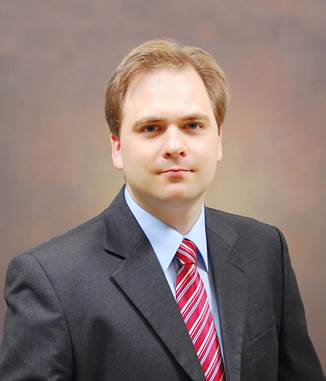
Professor
and Chair for Space Systems Univ.-Prof.
Dipl.-Ing. Dr. Martin TAJMAR EMail: martin.tajmar AT tuwien.ac.at Lecture 317.014 Advanced Space Propulsion Systems (WS, 2.0 h
/ 3.0 ECTS)
|
Research
Interests
§
Space Propulsion (Electric- and
Miniaturized Propulsion, New Concepts, „Breakthrough Propulsion Physics”)
§
Micro Power Sources and Converter
Technologies
|
Short
CV
|
Education
|
1999
|
PhD (Numerical Plasmaphysics)
|
Vienna University of Technology, Austria (with Distinction) |
|
1998 |
MSS (Master of Space Studies) |
International
Space University, France |
|
1997 |
Dipl.-Ing.
(Engineering Physics) |
Vienna University of Technology, Austria |
Awards
§ Best Paper Award – SPESIF Conference 2010 (Fiber-Optic-Gyroscope Measurements
Close to Rotating Liquid Helium)
§ GENIUS Ideas Competition 2009 – Special Award
(Innovative Energy Storage using Metal Hydrides as Fuel Cell Energy Recovery
System)
§ Ritter von Ghega Award –
Outstanding Innovation of the Year 2009 (1st Prize – Research
Centers, Innovative Hydrogen Storage in Hollow Glass Microspheres)
§ Outstanding Paper Award – STAIF Conference 2007 (Frame
Dragging of Spinning Superconductors)
§ GENIUS Ideas Competition 2007 – Award for
Environmental Technologies and Renewable Energy Sources (Microsphere Hydrogen
Storage System)
§ Outstanding Paper Award – STAIF Conference 2005
(Weight Measurements of Superconductors)
§ Creative Scientist of the Year Award 2004 (2nd
Prize)
§ ARCAward 2001 (1st Prize Science)
§ NRC Fellowship to NASA JPL (2000, declined for
position at ESA ESTEC)
§ US Air Force Window-On-Science Award (several prizes
throughout 2000-2006)
§ Austrian Research Community – International
Communication Award (1999)
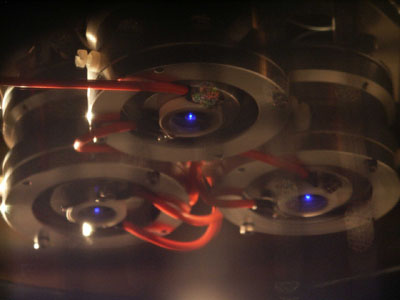
For more than a decade,
I’ve been developing several different propulsion systems. My main focus was on the realization of
Field-Emission-Electric-Propulsion (FEEP) thrusters, that enable ultraprecise
attitude- and orbit-control, required for next-generation science missions like
telescope interferometers or gravitational wave observatories. This engine
produces a thrust of 1-100 µN (even mN with a
recently developed multi-emitter). Such highly controllable thrusts enable
satellite formations to detect e.g. planets outside of our solar system (DARWIN) or gravitational waves as predicted by
Einstein more than 80 years ago (NGO).
My team cooperated and received contracts from NASA, ESA and major industry
such as ASTRIUM or research institutions such as the Max-Planck institute.
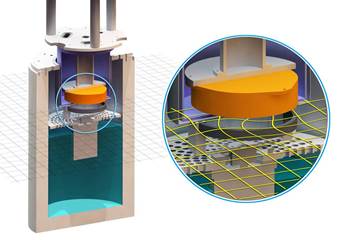
.jpg)
In addition to research on
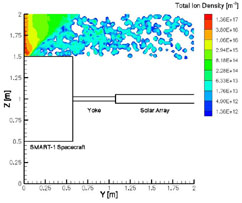
thrusters, I'm also developing high-performance numerical
plasmasimulations for electric propulsion thrusters.
These simulations are used to predict the plasma environment around satellites
and assess possible contamination and lifetime degradation issues. The software
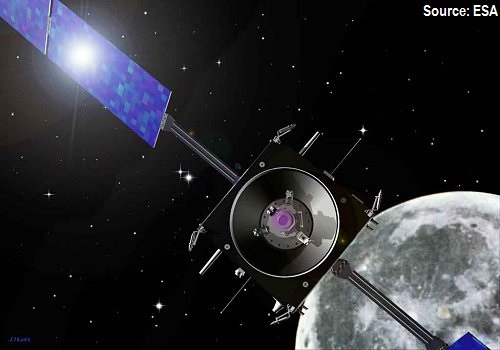
was used during my co-investigator assignment on the first European spacecraft
going to the moon - SMART-1, which was launched 2003.
My passion is to
investigate revolutionary propulsion concepts that can ultimately enable us to
build science fiction technologies like the starship Enterprise. Apart from
studies (e.g. for ESA - "Gravity
Control and Possible Influence on Spacecraft Propulsion: A Scientific Study"), I´ve carried out a number of
theoretical and experimental investigations such as gyroscope anomalies around
rotating mater/superconductors at low temperatures or the influence of
temperature on gravitation.
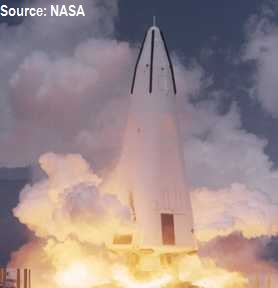
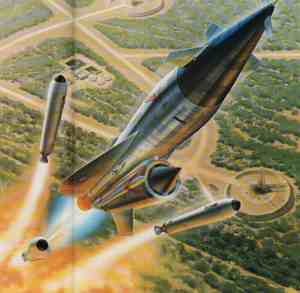
The advanced space
propulsion systems lecture gives an up-to-date overview of everything advanced
in propulsion. We assess traditional chemical rockets and look at advanced
propellants and new nozzle design, but also at advanced drag control, nuclear
ramjet propulsion or propellantless laser propulsion.
During the lecture, rare NASA and US Air Force video material will be shown
(Delta Clipper test flights, nuclear propulsion testing, etc.), several thrusters (such as a General Dynamics
Bi-Propellant Rocket Engine or our In-FEEP thruster) and prototyps
such as microfrabricated nozzles will be distributed
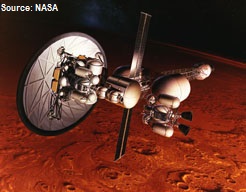
for hands-on experience. Get involved in an absolute fascinating topic and
let's discuss how Manned mars missions are possible or how we could reach other
solarsystems!
.jpg)
Selected Publications
Tajmar,
M., " Evaluation of Enhanced Frame-Dragging in the Vicinity of a Rotating
Niobium Superconductor, Liquid Helium and a Helium Superfluid",
Superconductor Science and Technology 24, 125011 (2011)
Tajmar, M., and Scharlemann, C.A., "Development of Electric and Chemical Microthrusters", International Journal of Aerospace
Engineering 2011, 361215 (2011)
Tajmar, M., Vasiljevich, I., and Grienauer,
W., "High Current Liquid Metal Ion Source using Porous Tungsten Multiemitters", Ultramicroscopy 111, 1-4 (2010)
Tajmar, M., "Homopolar Artificial Gravity
Generator based on Frame-Dragging", Acta Astronautica 66(9-10), 1297 (2010)
Tajmar, M., Sedmik, R., and Scharlemann, C.,
"Numerical Simulation of SMART-1 Hall Thruster Plasma Interactions",
Journal of Propulsion and Power 46(6), 1178 (2009)
(invited)
Tajmar, M., Scharlemann, C., Genovese, A., Buldrini, N., Steiger, W., and Vasiljevich, I., "Liquid-Metal Ion Source Development
for Space Propulsion at ARC", Ultramicroscopy 109, 422 (2009)
Hulman, M., and Tajmar, M., "Indium Ion Emission
from Nanotube Fibers", Nanotechnology 18, 495709 (2007)
Tajmar, M., "Influence of Taylor Cone Size on Droplet Generation in an
Indium LMIS", Applied Physics A 81(7), 1447 (2005)
Tajmar, M., Genovese, A., and Steiger, W.,
"Indium FEEP Microthruster Experimental Charactization", AIAA Journal of Propulsion and Power
20(2), 211 (2004)
Tajmar, M., and de Matos, C.J., "Gravitomagnetic
Field of a Rotating Superconductor and of a Rotating Superfluid", Physica
C 385(4), 551 (2003)
Tajmar, M., and Genovese, A., "Experimental Validation of a Mass
Efficiency Model for an Indium Liquid Metal Ion Source", Applied Physics A
76(6), 1003 (2003) (Rapid Communication)
Tajmar,M., "Advanced
Space Propulsion Systems", Springer, Wien-New York, 2003 (ISBN 3-211-83862-7)